SimpleX Chat
- 4.0
- Rating
- 1.00M
- Installs
- Free
- Price

 Analysis by App-foxy
I approached SimpleX Chat as a communication app for people who want more privacy than the usual messenger provides, but who still expect something usable for everyday conversations. After spending time with it, my impression is that its biggest strength is not a flashy interface or a huge collection of social features. It is the decision to build private messaging around a different identity model, with end-to-end encryption at the center and without relying on conventional user identifiers.
That choice makes the app interesting immediately, but it also changes how you think about inviting people, organizing contacts, and recovering access. This is not simply a familiar messenger with a privacy switch added on top. SimpleX Chat, developed by SimpleX Chat, asks you to accept a slightly different workflow in exchange for a stronger privacy-oriented design. For the right person, that trade-off is worthwhile. For someone who wants every friend to find them instantly by phone number, it can feel unnecessarily unfamiliar.
How the current app feels in daily use
SimpleX Chat sits in the communication category and is free to install, with an Everyone content rating. Its current version is 7.0, and it supports devices running Android 8.0 or newer. The app has passed over a million installs and holds an average rating of 4.0 from around 2.6 thousand ratings, which suggests a real audience but also a mixed experience depending on what each person expects from a private messenger.
You May Also Like

 Blood Strike: 2.5 Anniversary
Blood Strike’s Loadouts Turn Every Drop Into a Tactical Gamble
A close look at Blood Strike’s custom loadouts: how fast access to signature weapons reshapes its battle royale rhythm, rewards preparation, and narrows the gap between fights.

 Pandora - Music & Podcasts
Pandora’s Music Is Easy to Start, but Harder to Recover
Pandora’s strength is its low-effort path from a seed to a station. Its weak spot is how much confidence it asks you to place in connection, setup, and quiet recovery.

 8 Ball Pool
 Is Built on Rivalries, Rematches, and Routine
A close look at the rivalries, rematches, shared routines, and unanswered safety questions that turn a quick pool match into a persistent mobile community.

 Samsung Music
’s Quiet Strength Is Playing What You Already Own
Its reach comes less from spectacle than from dependable access to a personal library. That simplicity is both the app’s strongest retention engine and its ceiling.

 AccuWeather: Weather Radar
AccuWeather Review: A Quick, Clear Forecast for Everyday Decisions
For everyday plans, the best forecast is the one you can understand quickly. AccuWeather makes rain timing, radar, and local conditions easy to act on, with a few trade-offs.

 Hill Climb Racing
Why Hill Climb Racing Still Turns Crashes Into One More Run
A tiny car, a bumpy hill and one more upgrade: Hill Climb Racing keeps resurfacing because its simple chaos makes every near-miss feel personal.
More From Our News Desk



The first thing I noticed is that the app's privacy model affects the entire experience rather than appearing as a technical detail hidden in settings. Instead of making a phone number, email address, or public username the central way to locate somebody, SimpleX Chat uses invitation-based connections. In practical terms, you share a connection method with the person you want to contact, and the conversation begins from that deliberate exchange.
I like this approach when I am speaking with someone I do not want searchable by default. It reduces the feeling that an account is automatically exposed to a directory of users. It also makes a new conversation feel intentional: I decide who receives an invitation, rather than creating an address that can be guessed, copied, or reused everywhere.
The cost is convenience. With mainstream alternatives, a friend can often search a phone number, recognize a profile, and start a chat in seconds. SimpleX Chat requires both sides to understand its connection process. That is not difficult once explained, but it is one more step, and the people I invite need to be willing to follow a privacy-first routine rather than expecting the app to behave like a standard contact list.
A privacy model that changes the contact list
The absence of conventional user identifiers is the app's defining idea. I found that this matters most for people who separate different parts of their life: a private group of friends, a volunteer project, a sensitive work discussion, or a community where revealing a personal number would be uncomfortable. The app gives those conversations a more controlled starting point.
End-to-end encryption is also presented as a basic part of the service, not an optional premium feature. That is important because privacy is most useful when it is the default behavior of the conversation. I would still encourage anyone handling sensitive information to think beyond the messenger itself: the security of the device, notification previews, screenshots, backups, and the people in the chat all matter. No messaging app can make a careless endpoint private.
One practical habit helped me use it more confidently: I treated each new connection as something to verify before discussing anything sensitive. An invitation can establish a private channel, but it does not automatically tell me that the person is who they claim to be. For a close contact, I would confirm the connection through another trusted route first. That small step is easy to skip, yet it is more valuable than simply assuming that encryption solves identity verification.
The app's design also makes contact management feel less dependent on a global address book. That is a benefit if you dislike services that quietly turn your social graph into a discovery tool. It is less convenient if your main goal is to import everyone you already know and have the app populate itself automatically.
What the latest version means for existing users
Version 7.0 gives the app a current, maintained feel, but I would not interpret a version number alone as proof that every rough edge has disappeared. The important product evolution is visible in the way SimpleX Chat continues to present privacy as the organizing principle of the experience. It is not trying to become a conventional messenger first and a private tool second.
For an existing user, the practical question is whether an update preserves the workflow they already understand. My advice is to update deliberately rather than treating a new version as a reason to change every setting at once. Before installing a major update, I would review how I connect new contacts, where I keep important conversations, and what recovery options I have configured. Privacy-focused apps reward preparation because a little confusion during migration can be more disruptive than it would be in a typical social app.
I also see the current release as evidence of a product that is still refining a specialized approach rather than chasing every mainstream messaging trend. That is good news for users who value the core idea. It means the app's identity remains clear. At the same time, people expecting a familiar, frictionless experience should judge it by the workflow, not by the presence of a recent version number.
There is a subtle distinction here between product evolution and feature accumulation. A messenger can add menus and options without becoming easier to trust. SimpleX Chat's meaningful progress is better judged by whether its privacy model remains understandable while the surrounding experience becomes easier to operate. As a user, I would watch for improvements that reduce setup confusion without weakening the deliberate nature of its connections.
Where it works especially well
My favorite everyday scenario is a small group coordinating a sensitive project without wanting to expose personal phone numbers to every participant. Imagine a neighborhood group arranging support for someone, a freelance team discussing a client matter, or a community organizer working with people who have never met. I can share an invitation directly, keep the discussion inside an encrypted channel, and avoid making a personal identifier the entry point.
That workflow is particularly useful when the group is temporary. A conventional messenger may encourage people to add one another permanently to their address books, while SimpleX Chat better matches a conversation that exists for a specific purpose. I would still make a plan for closing or archiving the group afterward, because privacy is not only about starting a private chat; it is also about limiting how long sensitive material remains easy to access.
The app also suits people who want a separate communication space for online communities. If I participate in a forum, support group, or hobby project, I may not want to connect that activity to the number used by family and banking services. A privacy-oriented messenger gives me a cleaner boundary. That separation is one of the strongest reasons I would recommend trying it.
Another non-obvious advantage is psychological: the invitation model makes me pause before adding a contact. In a world where messaging apps encourage broad discoverability, that extra pause can reduce accidental exposure. I am less likely to assume that a person should automatically have access to my conversation space simply because their number is in my phone.
The friction you should expect
The same design that protects discoverability can slow down ordinary social use. If my family already lives inside a mainstream messenger, moving everyone to SimpleX Chat requires explaining why the connection process differs and why they should maintain another app. The technical argument may be sound, but convenience is a powerful force, especially for relatives who only want to tap a familiar contact and send a message.
This is also not the app I would choose for a public-facing communication strategy where people need to find an organization quickly. A business that depends on searchable contact details, broad customer reach, or a recognizable public profile may be better served by a conventional platform. SimpleX Chat is strongest when the conversation should be deliberately established, not when maximum discoverability is the goal.
There is a learning curve around privacy itself. New users may wonder how to invite someone, how to recognize a trusted connection, or what happens if they change devices. Those are not trivial questions, and I would not install the app for a less technical friend without being ready to help with the first setup. The app's privacy model is understandable, but it is not as socially automatic as the phone-number-based systems most people know.
I also found that privacy can create responsibility. With a standard service, users often rely on familiar account recovery habits and broad contact synchronization. A more deliberate system encourages me to think about access, invitations, and device changes before they become urgent. That is a strength for careful users, but it can feel like work for anyone who wants the messenger to manage everything invisibly.
How it compares with familiar messengers
Compared with phone-number-centered apps, SimpleX Chat offers a more private starting point because the relationship does not depend on exposing that number as the primary identity. The trade-off is that contact discovery is slower and less automatic. If I care most about bringing an existing address book into a chat service with minimal effort, the familiar alternative wins.
Compared with privacy-focused messengers that still use a stable username or account identity, SimpleX Chat takes a more radical position on identifiers. That can reduce the amount of information attached to a connection, but it may also make social continuity feel less obvious. A persistent identity is convenient when I want people to find me again; a deliberately created connection is preferable when I want each relationship to be controlled.
Compared with ordinary SMS, the app is a much better fit for private conversations, provided the other person is willing to install and learn it. SMS remains easier for reaching almost anyone, while SimpleX Chat makes more sense when both participants actively care about the communication channel. I would not use it as my only way to contact people who are unlikely to adopt a separate messenger.
Compared with large social platforms, it is refreshingly focused. There is less temptation to treat messaging as part of a public profile or a broad social feed. That focus is exactly what I want in a private conversation tool. It also means I should not expect the same network effects, casual discovery, or entertainment features that make social platforms sticky.
Questions I would settle before switching
The first question is whether the app is really free to start using. Yes, it is listed as free, so there is no purchase required simply to try the messenger. There are in-app purchases ranging from $6.99 to $420.00 per item, however, so I would check the purchase screen carefully before confirming anything. For a basic trial, I would begin with the free experience and only consider an optional purchase if I understood exactly what it added.
The second question is whether it is suitable for a mixed group of technical and non-technical users. My answer is: sometimes, but plan the introduction. A small group can adapt if one person explains invitations and connection verification clearly. A large family or casual club may resist the extra steps, especially if everyone already uses a familiar messenger. The app is easier to recommend when privacy is a shared priority rather than a benefit only one participant cares about.
The third question is whether the app should replace every other messenger. I would not make that recommendation. I see it as a strong specialist option for private conversations and carefully controlled contacts, while a mainstream service may remain more practical for broad reach. Keeping both can be sensible: use SimpleX Chat where identity separation matters, and use the conventional app where convenience and existing contacts matter more.
The fourth question concerns device changes and access continuity. My practical advice is to study the app's own account and connection-management screens before you need them, especially if your conversations matter. Do not wait until a lost or replaced phone forces you to discover how your private setup works. This is a general discipline I would apply particularly strongly here because the app intentionally avoids treating a public identifier as the universal key to your social life.
The final question is whether the Everyone rating makes it appropriate for all ages. It indicates broad content suitability, but younger or less experienced users may still need guidance about invitations, impersonation, and sharing sensitive information. A safe rating does not remove the need for ordinary digital judgment.
Who should use it, and who should skip it
I would recommend SimpleX Chat to privacy-conscious individuals, small groups, activists, community organizers, freelancers, and anyone who wants communication separated from a personal phone number. It is also a good fit for people who are comfortable explaining a slightly different workflow to their contacts. If you value control over discoverability more than instant convenience, the app's central design makes sense.
I would hesitate to recommend it to someone whose priority is effortless adoption across a huge contact list. If your friends will not install another messenger, or if you need customers to locate you without an invitation, the app may become an isolated tool rather than a useful communication network. I would also suggest caution for users who dislike managing their own privacy choices; the deliberate model is rewarding, but it asks for attention.
My strongest practical tip is to begin with one trusted contact instead of moving an entire social circle at once. Use that first conversation to understand invitations, identity confirmation, notifications, and the way you want to organize private chats. Once the process feels natural, expand gradually. This avoids the common mistake of judging the app during a rushed group migration when nobody has learned the workflow.
What I would watch next
As the product continues evolving, I would pay attention to whether new improvements make onboarding clearer without turning the service into another identifier-driven network. The ideal direction is not simply more buttons. It is a smoother explanation of the privacy model, easier handling of real-life contact changes, and fewer moments where a new user wonders what to do next.
I would also watch how well the app balances privacy with recovery and continuity. Private communication is valuable only when people can use it reliably over time. Any refinement that helps users understand their connections, protect access, and manage device transitions would have a meaningful effect on existing users, even if it is less visible than a headline feature.
My final view is positive but specific. SimpleX Chat is not the universal replacement for every messenger, and its invitation-based approach will never be as effortless as searching a phone number. Yet that friction is connected to its main value: privacy is treated as the foundation of the conversation, not a decorative setting. I would choose it when controlling who can reach me matters more than being instantly discoverable. If that describes your situation, this free communication app is worth learning rather than judging after a quick first launch.
FAQs for SimpleX Chat
01What is SimpleX Chat, and how does it protect my privacy?
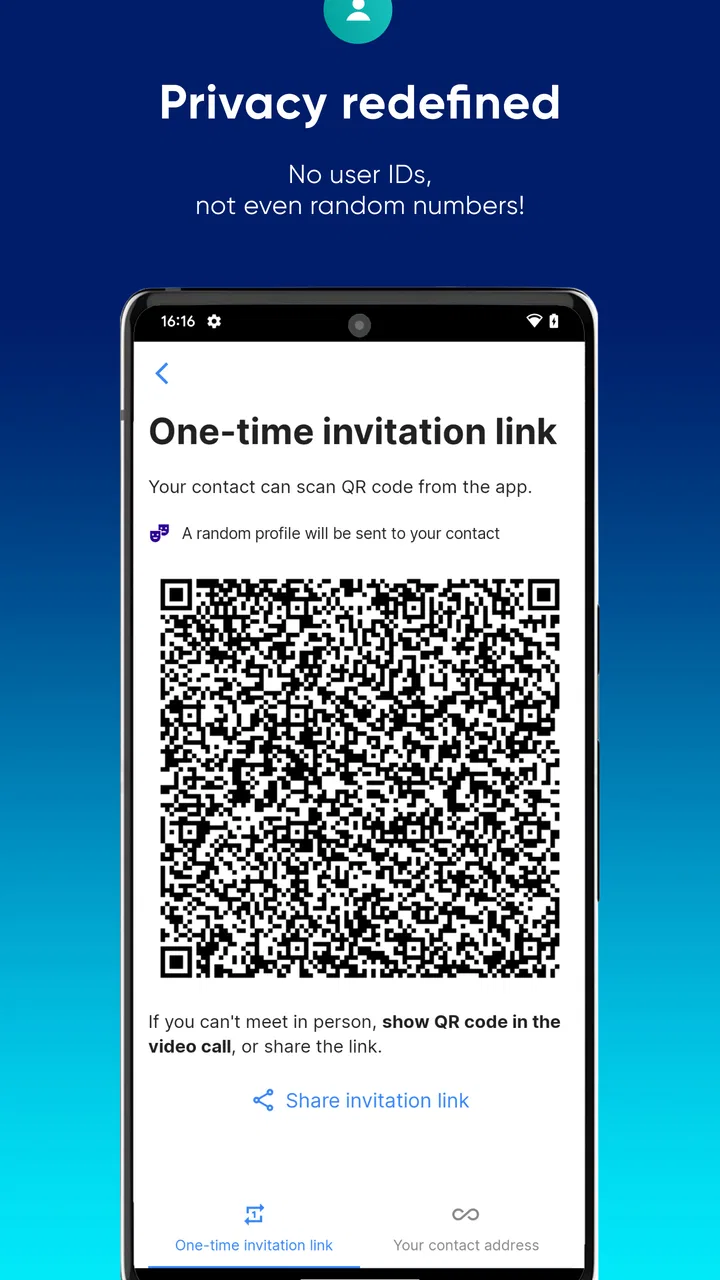
SimpleX Chat is a privacy-focused messaging app designed to let people communicate without permanent user IDs, phone numbers, usernames, or public profiles. Instead, conversations are established through one-time invitation links or QR codes. The app uses end-to-end encryption, and its design aims to minimize metadata, meaning the service is intended to learn as little as possible about who communicates with whom. However, privacy also depends on your device security, notification settings, and how carefully you share invitations.
02Do I need a phone number, email address, or account to use SimpleX Chat?
No traditional phone number, email address, or centralized account is required to start using SimpleX Chat. You create connections by sharing an invitation link or scanning a QR code, which can be useful for users who do not want to expose personal contact details. The setup may feel less familiar than ordinary messaging apps, because finding contacts is not based on a searchable address book. You must exchange invitations directly and manage your connections yourself.
03Can I use SimpleX Chat for group conversations, voice calls, and file sharing?
SimpleX Chat supports more than basic one-to-one text messaging, including group conversations and additional communication features that may vary by platform version and release. Depending on the current app build, users may be able to exchange media or files and use voice or video communication. Performance can depend on network conditions, device permissions, and relay availability. Before relying on it for important calls or large transfers, it is sensible to test the specific features on your device.
04Is SimpleX Chat free, and are there any limitations or technical requirements?
SimpleX Chat is generally available as a free application, although its infrastructure and optional services can change over time. The app requires a compatible Android or iOS device, an internet connection, and permissions needed for notifications, microphone, camera, or file access when using those functions. Because it prioritizes privacy and decentralized-style connection options, initial setup can be more technical than mainstream messengers. Users should also keep the app updated for security fixes and feature improvements.
05What are the main disadvantages of using SimpleX Chat?
SimpleX Chat offers strong privacy advantages, but it is not necessarily the easiest messenger for everyone. Contacts cannot simply search for your name or phone number, so invitations must be exchanged manually. Some friends may be reluctant to install another app, and certain advanced features can require additional configuration or explanation. The user interface may also feel less polished or familiar than larger messaging platforms. Losing access to your device or account data can make recovery and contact management more complicated.
Pros
- No phone number
- or username is required to create an account.
- End-to-end encryption protects messages
- calls
- and shared files.
- Multiple profiles help separate personal
- work
- or community conversations.
- Self-hosted servers are supported for users seeking more control over infrastructure.
- Open-source code allows independent review of its privacy and security design.
Cons
- Finding friends can be harder because there is no global username directory.
- Some contacts may need an invitation link or address to start chatting.
- The interface can feel less familiar than mainstream messaging apps.
- Features and settings may take time to understand for first-time users.
- Message delivery depends on relay servers unless contacts connect directly.

SimpleX Chat
Gallery